

25 Ways to Support Your Highly Sensitive Child in 2025
In 2025, the world continues to be an overstimulating, fast-paced environment—full of constant noise, digital distractions, and societal pressures. For highly sensitive children (HSCs), this can feel overwhelming. As parents, caregivers, or educators, we can provide the steady, loving support that allows them to thrive, showing them how to embrace their sensitivity as a gift, not a burden.
If you are raising a HSC, you’ve likely noticed their acute awareness of emotions, subtle details, and sensory experiences. It can sometimes feel like the world is too much for them to handle, but thankfully there’s a growing trend to celebrate and nurture sensitivity in a way that fosters resilience and joy. And it starts with us, the parents and educators of HSCs.
Here are 25 ways to support your HSC in 2025. The focus is on understanding, using practical tools, and employing empathy that will help your child thrive in an ever-changing, uncertain and at times scary world.
25 Ways to Support Your HSC
1.Acknowledge Your Child’s Sensitivity
Validation is key. Let your child know that being sensitive is a beautiful and unique trait. Acknowledge their feelings and experiences without trying to minimise or dismiss them. In other words, acknowledge, accept and help your child embrace their sensitive traits!
2. Create a Calming Routine
HSCs in particular thrive on predictability. Set up daily routines that are soothing and give your child a sense of control over their environment. This might be choosing clothes to wear for the next day before bedtime, when there are fewer time restraints than in the morning when you are rushing to get out of the door. It may include quiet time before bed or a calming ritual after school.
3. Create a Safe Space Your HSC Can Retreat
Create a physical space where your child can retreat when they need to empty their bucket. This could be a cozy corner with soft blankets, pillows, and comforting items like their favourite stuffed animals or books, a reading nook, or a tent to chill in. Put a bucket box together and keep it in their quiet corner.
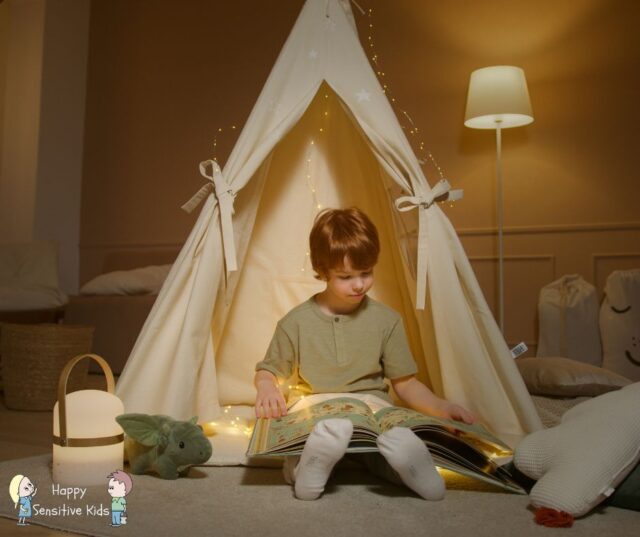
Tip: Items to help you set up a quiet corner
4. Be Mindful of Sensory Input
HSCs are often more sensitive to sounds, lights, textures, and smells than their non-HSC peers. Pay attention to environmental factors that might overwhelm your child and adjust as needed (e.g., soft lighting, noise-canceling headphones, and minimise clutter).
5. Help Them Identify Their Emotions
Encourage emotional literacy by helping your child name and understand their feelings. Use tools like emotion charts, books, or apps to help your HSC recognise and express their emotions in healthy ways. You can download the HSK ‘My Feelings’ Thermometer to help.
6. Teach Self-Regulation Techniques
Help your child develop coping strategies for when they feel overwhelmed. Deep breathing, grounding exercises, or even gentle stretches can help them regain balance and self-control.
7. Limit Exposure to Overstimulating Media
In the digital age, overstimulation from screens is a real concern. Set healthy limits on screen time, and be mindful of the content they consume. Opt for calm, educational shows and apps that promote mindfulness.
8. Foster Empathy and Compassion
HSCs tend to be more empathetic than their peers, so encourage this strength by teaching them to recognise others’ emotions and practice kindness. Helping them navigate social dynamics can build their confidence and sense of connection. It will help them to see the positives about being highly sensitive, so long as traits are understood and mastered.
9. Encourage Creative Expression
Let your child express themselves through art, music, or writing. Creative outlets can help them process their emotions and thoughts, providing an invaluable outlet for their inner world. Try to nurture this creative expression – so many of us lose this as we move to adulthood.
Reading Tip: 50 Ways for Highly Sensitive People to Unleash Their Creativity
10. Promote Positive Affirmations
Developing a positive self-image is crucial. Teach your child to use affirmations to remind themselves of their strengths, like “My sensitivity is a gift,” and “It’s hard but I’m going to do it anyway.”
Tip: Download the HSK affirmations
11. Establish and Protect Boundaries
Help your child understand the importance of boundaries by modelling and respecting their personal space. Teach them that it’s okay to say no when something doesn’t feel right. Highly sensitives are people pleasers and learning to establish boundaries in early life will bear fruit as an adult.
12. Use Gentle Parenting Techniques
Gentle, respectful parenting helps highly sensitive children feel understood and secure. This includes listening actively, speaking in a calm voice, and offering consistent guidance. HSCs respond well to gentle discipline.
13. Prioritise Quiet Time
In a world that demands constant activity, your child needs moments of stillness. Bucket time. Quiet time, whether alone or with a sibling or parent, allows your child to recharge and connect with their inner world. This blog is full of tips and advice about bucket time and how to empty a child’s bucket.
14. Nourish Their Need for Nature
Spending time outdoors in nature can be incredibly grounding for sensitive children. Whether it’s a walk in the park, gardening, or simply observing the natural world, these moments offer peace and healing.
15. Practice Mindfulness Together
Introduce your child to mindfulness practices like meditation or yoga. Doing these activities together can deepen your bond while helping your child develop focus and relaxation skills. Mindfulness practices are a fantastic way to empty your child’s bucket.
16. Support Their Social Needs
Social interactions can be challenging for HSCs. Be aware of your child’s social needs and create opportunities for them to interact with peers in smaller, more manageable settings. It helps if the environment is at least familiar when meeting new people, so scout out new venues in preparation of new social interactions. Make sure your child is as comfortable as possible – physically and emotionally. Taking a child out of their comfort zone can be done with the right preparation.

17. Be an Active Listener
Sometimes, all your child needs is someone to truly listen. Practice active listening by giving them your full attention, acknowledging their feelings, and validating their experiences. If they are ready to tell you how they feel, make sure you are ready to listen.
18. Encourage Positive Friendships
HSCs can be very selective about their friendships. For HSCs (and HSPs) it is often more about quality than quantity. Support them in building positive relationships with empathetic and understanding peers who can appreciate their sensitivity. Guide your HSC to follow their instincts and steer them away from negative, dominant relationships – highly sensitives often find it diffcult to say no and guard their boundaries.
Tip: 8 Reasons You’ll Be Glad to Have an HSP as Your Best Friend
19. Limit Distractions at Mealtimes
Mealtimes can be a sensory overload for sensitive children. Create a calm, distraction-free eating environment, focusing on nourishing both body and spirit.
20. Teach Your HSC to Advocate for Themselves
Help your child find their voice. Teach them how to express their needs and feelings in an appropriate way, whether it’s telling a teacher they need a break or expressing discomfort in a social situation. Until they are old enough, you will have to advocate for your HSC, particularly in school, but this doesn’t mean you can’t teach them to take over that role as they get older.
21. Encourage Physical Activity
Exercise is a great way to help your child release built-up tension and stress. Find physical activities they enjoy, like swimming, biking, or dancing, that will help them feel grounded and energised. A busy swimming pool or gym can be overwhelming, so be sure to find an activity that fits your HSC or tools that will help your child in those environments. Often, HSCs will prefer individual pursuits over team sports, but with guidance and trial, a HSC will find the right physical activity for them.
22. Work with Their Teachers
Collaborate with your child’s school to ensure your HSC gets the right support in their classroom, particularly when they are young or just starting school. Teachers can help by offering accommodations like quiet spaces or giving your child time to adjust to new routines or transitions. They can warn of changes to the usual routine, or look out for signs that your child’s bucket is filling, or full.
23. Model Emotional Self-Care
Children learn by watching their parents. By taking care of your own emotional well-being, you model healthy coping mechanisms and self-compassion for your child. If you make a point of taking time to empty your won bucket, or better still, from stopping your own bucket from filling, your child will follow your example. Start early.
24. Be Patient with Transitions
Transitions—whether it’s from home to school or from one activity to another—can be particularly challenging for HSCs. Give them plenty of time to adjust and offer reassurance as needed. Let them know in advance that you are leaving, or changing activity, for example. Be patient if they struggle with the transition, or even the idea of a transition.
25. Celebrate Their Sensitivity
Above all, celebrate your HSC’s sensitive nature. Whether it’s their ability to sense someone’s feelings, their seemingly never-ending creativity, or their strong intuition, encourage them to embrace their gifts. Sensitivity is not a flaw to fix—it’s a strength to nurture. The earlier we teach our children this, the better!
Final Thoughts
Supporting your HSC in 2025 means fostering an environment of understanding, patience, and acceptance. By providing them with the tools and resources they need to navigate an overwhelming world, we empower them to fully embrace their unique nature. HSCs have the potential to bring great depth, empathy, and insight to the world, and with your love and support, they can grow into resilient, confident individuals.
Remember, the journey of supporting a sensitive child is not about “fixing” them—it’s about helping them shine brightly in a world that may not always understand their gifts. Let’s give them the space to flourish and feel truly seen.
*For your convenience, this post includes affiliate links to products useful for the HSK community. They cost you nothing more to buy, but I may get a small commission, which goes towards costs to keep the HSK site running.*


