

Highly Sensitive Children Seem Like a Teacher’s Dream – They Are Not
Quiet children in the classroom don’t draw attention to themselves. A highly sensitive child may seem like a teacher’s dream student. But often they are not. Here’s why.
A Highly Sensitive Child in the Classroom
My highly sensitive child (HSC) seems like a teacher’s dream student.
He does his work and follows instructions. He wants to please. He’s compliant. He doesn’t make waves. He’s quiet. He is conscientious. And wants to do his best.
He doesn’t want to stand out in the classroom. He doesn’t make a fuss.
Quiet Children in a Classroom Are Not on a Teacher’s Radar
In a class of more than thirty children quiet children in the classroom barely make a bleep on a teacher’s radar.
It’s not that his teacher didn’t know he was there, it’s just looks like everything is ticking over nicely and he doesn’t need her attention. There are other children who need her more. The ones who make it obvious that a teacher’s help is needed.
Adept at Hiding Emotions
It’s something that first struck me when my eldest was five years old. I came to school at the end of the morning to pick him up for lunch and I could see in his eyes, hear in his curt clipped responses to my questions, that his emotions were close to spilling over. Those are the emotions he kept buried deep inside whilst in his busy, noisy classroom.
I’d put my arms around him and feel the energy raging within his little body, stress with nowhere to go. We’d walk home. Sometimes there were tears on the way, sometimes the beginnings of a meltdown. Or worse still there was silence.
The Impact of School on a Highly Sensitive Child
As I opened our front door and he stepped over the threshold to safety, he’d let his emotions go. Sometimes it was rage, anger and aggression that flew out of his taut body.
Sometimes it was an inexplicable meltdown that he didn’t understand.
Other times, he bounced from one activity to the other, not being able to concentrate, not being able to slow down. He didn’t know what to do with the energy racing around him.
When I told him it was time to go back to school the battle commenced. I’d have to drag my little boy back over the threshold of safety back into the outside world, both of us usually in tears.

What a Teacher Doesn’t See
It was a scene his teachers never saw, could never imagine happening.
They never saw the bruises on my shins as my HSC kicked out in his physical attempts to stay home each afternoon.
They never saw my tears nor the agonising conflict within me. I wanted to keep him home, protect him, make him feel safe, but I couldn’t – not every day.
By the time he was back in school a truce had been called. Our tears had dried up, his anger had subsided and he was resigned to his afternoon in school.
I’d tell the teacher about the drama we had been through to get him back to school but I faced a brick wall. The image I shared didn’t match the picture of the same quiet, neutral boy in her classroom.
He’s a Model Pupil Here, It’s Your Problem at Home
They’d tell me he’s a good learner, a model pupil. They’d tell me that he’s never had a tantrum in school, never kicked a chair in frustration, never raised his voice in anger in the classroom. He’d never made a fuss.
The teachers refused to scratch below the surface, to look beyond the introverted highly sensitive facade. They refused to believe what they hadn’t witnessed first-hand.
“It’s a problem for you to sort out at home, not for us at school. We don’t see a problem here,” his teacher said.
Quiet Highly Sensitive Children Need Help in the Classroom
Young highly sensitive children have not learnt to use tools to filter out unnecessary sensory input. They need support with that task.
They need a prompt to seek out quiet moments. These children need help in the classroom to prevent their overwhelm spilling out at home where and when they feel safe.
Mine is a common story.
A Message to Teacher with Highly Sensitive Children in Their Class
The mantra ‘seeing is believing’ has no place when you are responsible for the education of a highly sensitive child.
A highly sensitive child needs a teacher to give their parents the benefit of the doubt, even when they can’t see the upset and meltdowns for themselves first hand.
Highly sensitive children need teachers to give their parents the gift of trust.
A highly sensitive child needs a teacher to give him the support he needs in the classroom without having to see him at his worst.
Highly sensitive children may seem like a teacher’s dream. But actually they are not.
They have two intrinsically linked parts to them: the child a teacher sees in the classroom and one their parents see in the safe haven of their home.
HSCs are difficult to read in the classroom. He won’t come to you when there is a real problem. She needs to trust you completely to feel comfortable.
If you speak once in anger to him his confidence is shaken to the core and he won’t approach you when he needs your help most.
He finds the days long and tiring.
She’s bored easily because she understood your instructions and meaning the first time around but they are repeated for her classmates.
He has a wandering mind, distracted by all the activity going on around him, which means he misses some instructions – and then panics.
He’ll save up his anger, anxiety, his sadness, his sense of injustice and pour it all out at home, where no teacher can see it.
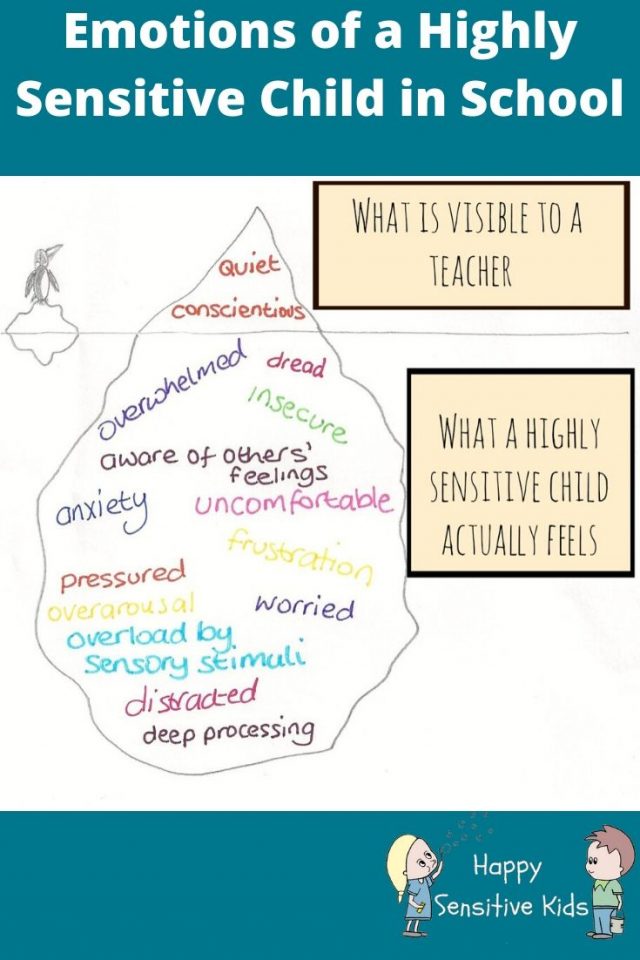
In Short: Quiet Children in the Classroom
When it comes to highly sensitive children, a teacher will invariably see a very different child in the classroom than the one their parents see at home. And so understanding this is the first step to really helping a highly sensitive child blossom in an environment that is usually anything but optimal for a HSC.
Top Tip from Elaine Aron for teachers from her book “The Highly Sensitive Child: Helping Our Children Thrive When the World Overwhelms Them”:
Work closely with the parents of your HSCs. They often have useful insights and strategies for working with their children. They also need reassurance from you: At home they see a bright, competent, outgoing child and fear that at school you will see someone quite different.
Over to You
Is this a problem you recognise? Are you raising a quiet child, who doesn’t always ask for help when the need it? What are your best tips for helping a quiet child?


Fantastic post, Amanda. I know of so many children like this. The relief when my kids left school was enormous – finally I was able to have a relationship with the whole, delightful child rather than the grumpy, stressed-out bits that were left at the end of a draining day of holding everything in at school. (And they were only 5 and 6 at the time!) Not all parents are in a position to home-educate, though, so I completely agree with your point that schools need to listen to, believe, and trust parents. Well done for helping spread the word!
The iceberg is spot on. My son was only in school for part of kindergarten but it was the most difficult year of my life. I watched my son go from being friendly, curious, loving the library and books to total raging meltdowns (which happened at home not school as you indicated) and a complete hatred of books and learning. The kindergarten environment was totally chaotic (I volunteered in the room and was totally overwhelmed myself) and the remedial teacher started to imply that my son had ADHD because he couldn’t concentrate in such a hectic environment. She was also very critical of his efforts to learn to read and write, forcing him to correct his “bad” work over and over. His self esteem plummeted alarmingly and he just became an angry, shut down child. Shortly after winter break I pulled the plug and we’ve homeschooled ever since. It’s been a challenge in other ways. My son is an only child and I’m a HSP so it can be a very intense relationship with the two of us at home. My son is also introverted, so it can be hard to connect to make friends. It’s taken a long time to heal the wounds that his school experience caused. My son still won’t go to the library four years later which makes me cry if I think about it too much. There’s so much I wish I had known prior to our school experience because in some ways I feel like I could have made the experience so much better (?) Maybe, maybe not. He did well in his small, private preschool, so I was blindsided by the public school kindergarten experience where we lived at the time. I definitely would have held him back a year since he is an August birthday and had him start when he turned 6 instead of 5.. I also would have tried a small, private school. Would it have helped. We’ll never know.
My oldest son can certainly be considered “highly sensitive”. There is no formal diagnosis for this kind of label, however, he is on the autism spectrum with PDD so the two character traits are often linked together. We encourage a home where feeling are shared in moments of anger, sadness and fear.
I was a very sensitive kid growing up so it becomes extremely easy to empathize with the emotions he faces on a day to day basis. No one tells you that parenting will cultivate a sense of patience in you like it or not 🙂
I think the most important thing is teaching your child to vocalize their feelings. When they can do that, they can rationalize and talk their way out of a tough spot. Thanks so much for this article – it was very fitting for me.
This is absolutely my experience too, and is also the reason I removed my son from his first primary school. We just switched schools rather than opt to home school, but it was the best thing we ever did. I would add another ‘problem’ to the life of HSCs at school, and that is that the very nature of HSCs makes them good role models for other children who have more difficulty with adhering to expected standards of behaviour, and so can find themselves ‘used’ by the school as a kind of ‘mentor’/buddy for other children – in one way this is great BUT as we found, it leads to all sorts of issue for the HSC who is not only dealing with their own overwhelm, but that of the other child too – and the teachers don’t see it, because it’s all under the ice-berg. The battle we had was in getting the school to see that whilst he didn’t have behavioural or emotional ‘issues’ by using him in this way, they were adding to his emotional overwhelm, but not giving him any support or respite – it continually became ‘his issue to deal with’, they kept saying that they always ask him if he’s happy to befriend, but of course as an HSC being asked by an adult to do something – is he ever going to say NO?! Of course not – they shouldn’t put him in that position in the first place – but they just could not see that. His second school was such a completely contrasting experience, and he even volunteered to be a Peer Mentor, a system that was properly supported. He’s now at secondary school , where they somehow seem to be a bit more accommodating of the needs of HSCs (Perhaps because study is more focused and there is more formal teaching and less tolerance of general chit-chat in learning environments) – there is still a huge emphasis on verbal participation though, I have yet to have that conversation!
A great post and so true. This was not an issue at our HSC’s small well-structured primary school but has become an issue at secondary school (when we discovered she is highly sensitive). Thankfully the school is keen to work with us but it’s difficult to know how much they realistically can do in a school with 150 girls in each year! It means we have to be hyper-vigilant at home and sadly also means our weekend time has to be quieter and more well-managed than we would like for us to have a happy home life.